01 · Begin
A clear starting point
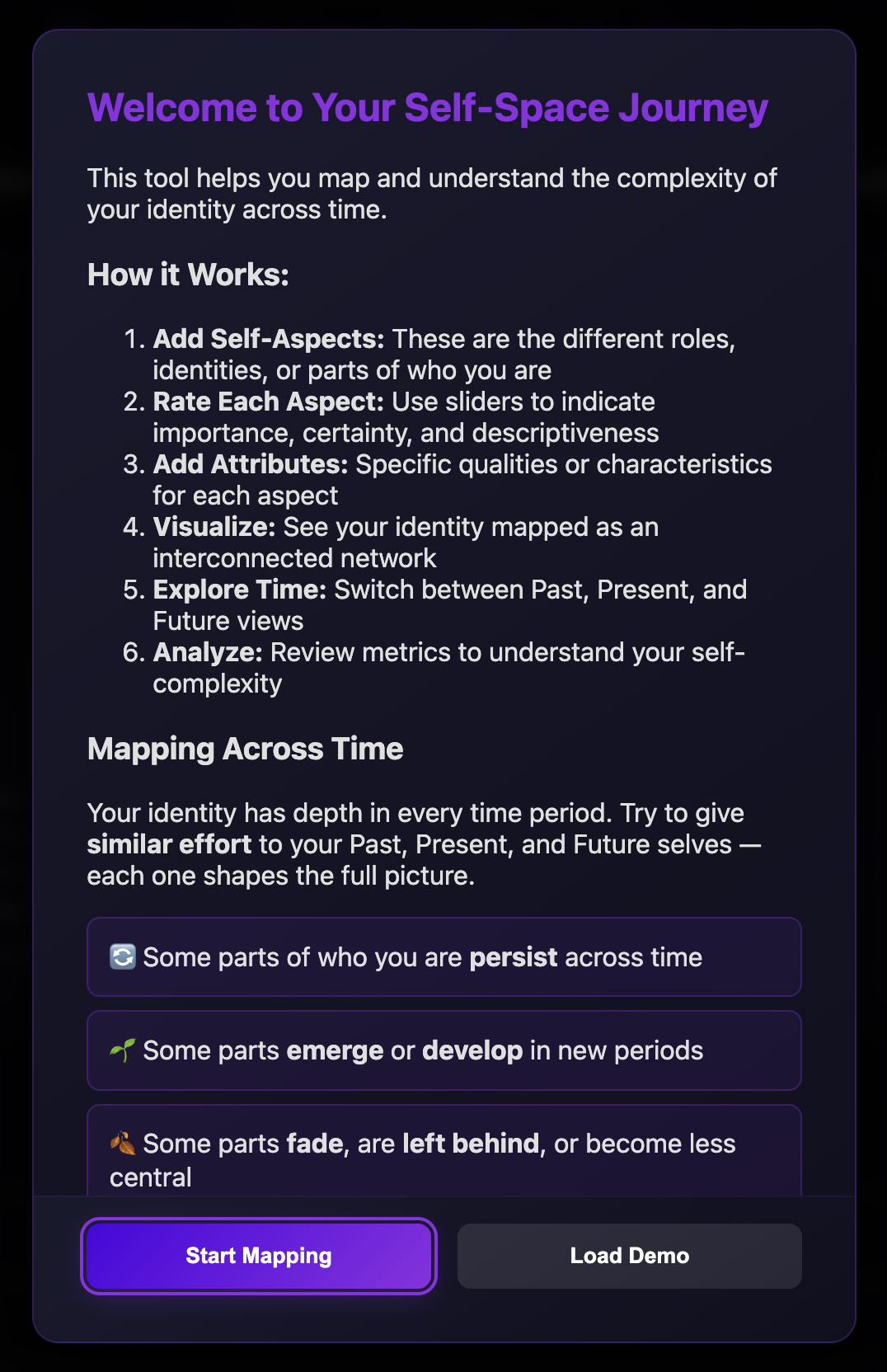
Whether the user is a research participant or exploring on their own, the app sets up the right session from the very first screen.
A new platform for measuring, visualizing, and analyzing self-complexity across time.
From individual identity mapping to publishable research outputs.
📐 Standardized Measurement Specification for formulas, guidance, and citation.
public hub built to reconnect and reboot a fragmented field
aligned layers: reboot project, research network, and Illinois initiative
applications across psychology, health, education, business, leadership, performing arts, and more
Self-complexity has been influential for decades, but difficult to measure, compare, and scale. This platform changes that. It brings together structured identity mapping tools, reproducible measurement systems, interactive network visualizations, and publication-ready outputs in one unified, open framework.
The fastest way to understand this ecosystem is to see the workflow. These screens show how identity is mapped, structured, visualized, and translated into research-ready analytics.
Whether the user is a research participant or exploring on their own, the app sets up the right session from the very first screen.
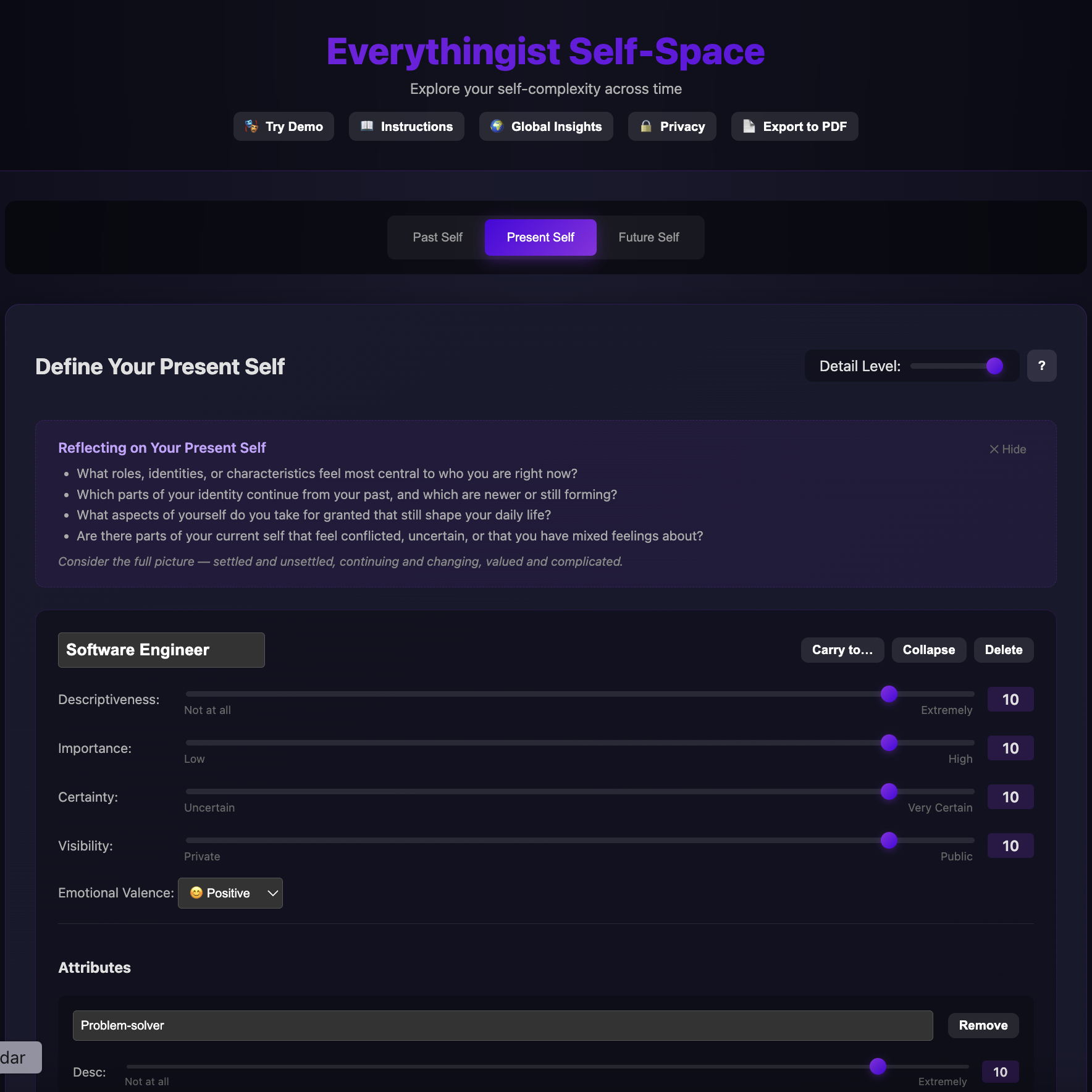
Users specify roles and attributes across past, present, and future, rating each on importance, certainty, descriptiveness, visibility, and emotional valence.
Three panels — past, present, future — show how self-aspects shift in centrality, emerge, fade, and reorganize. The visual fingerprint of self-complexity.
Most research hubs explain ideas. This one runs the tools alongside them. The app and dashboard are one click away, not buried behind a roadmap.
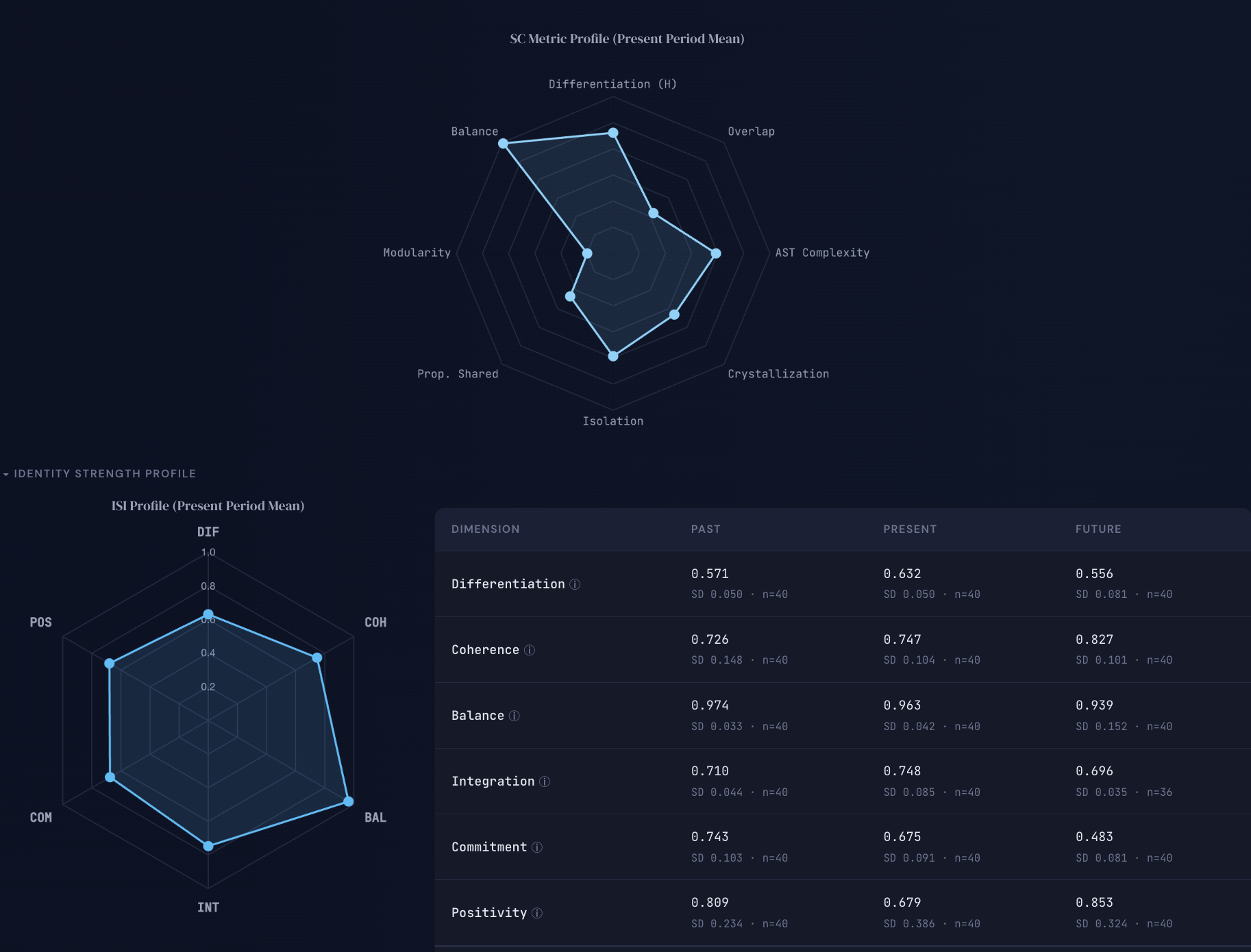
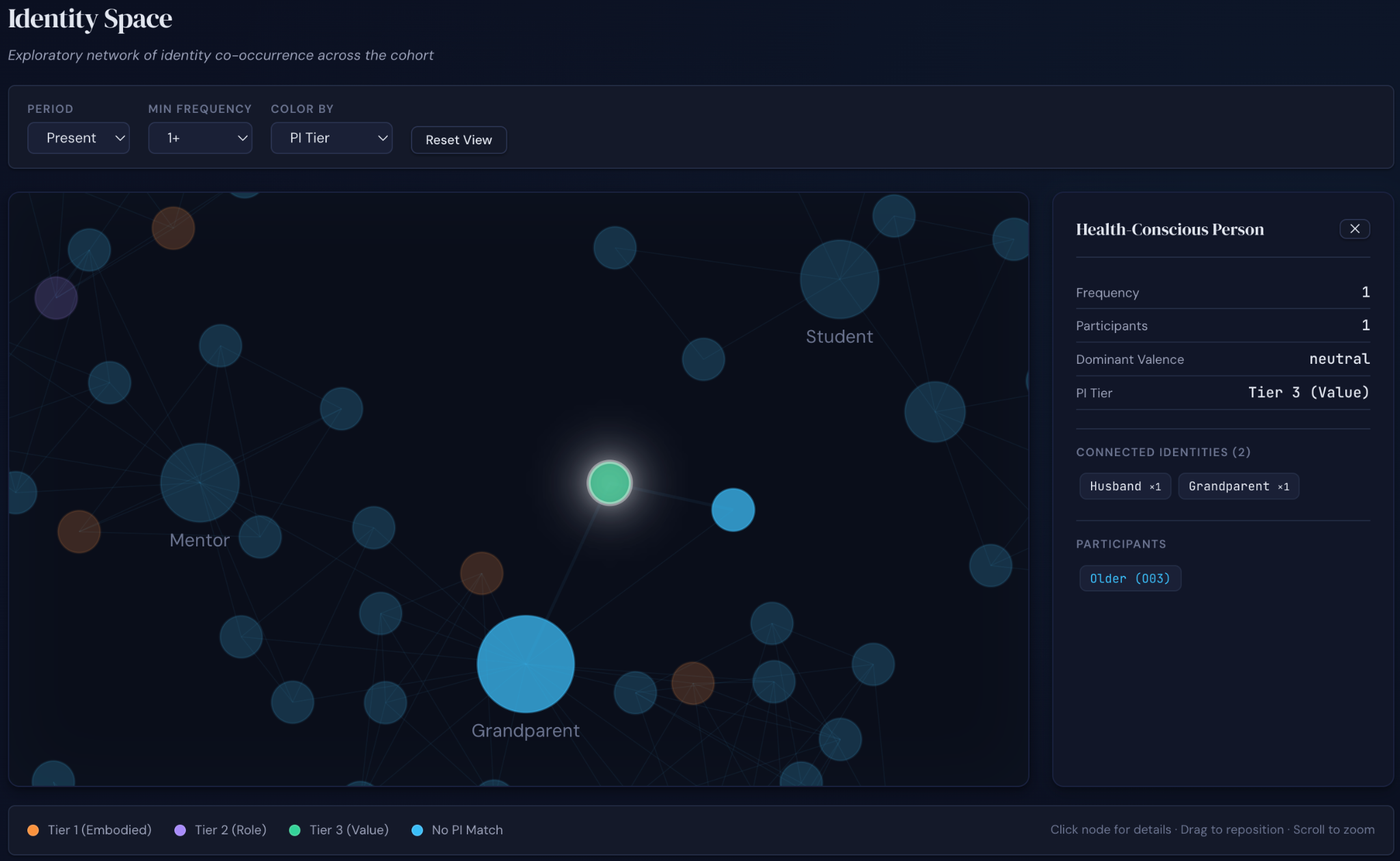
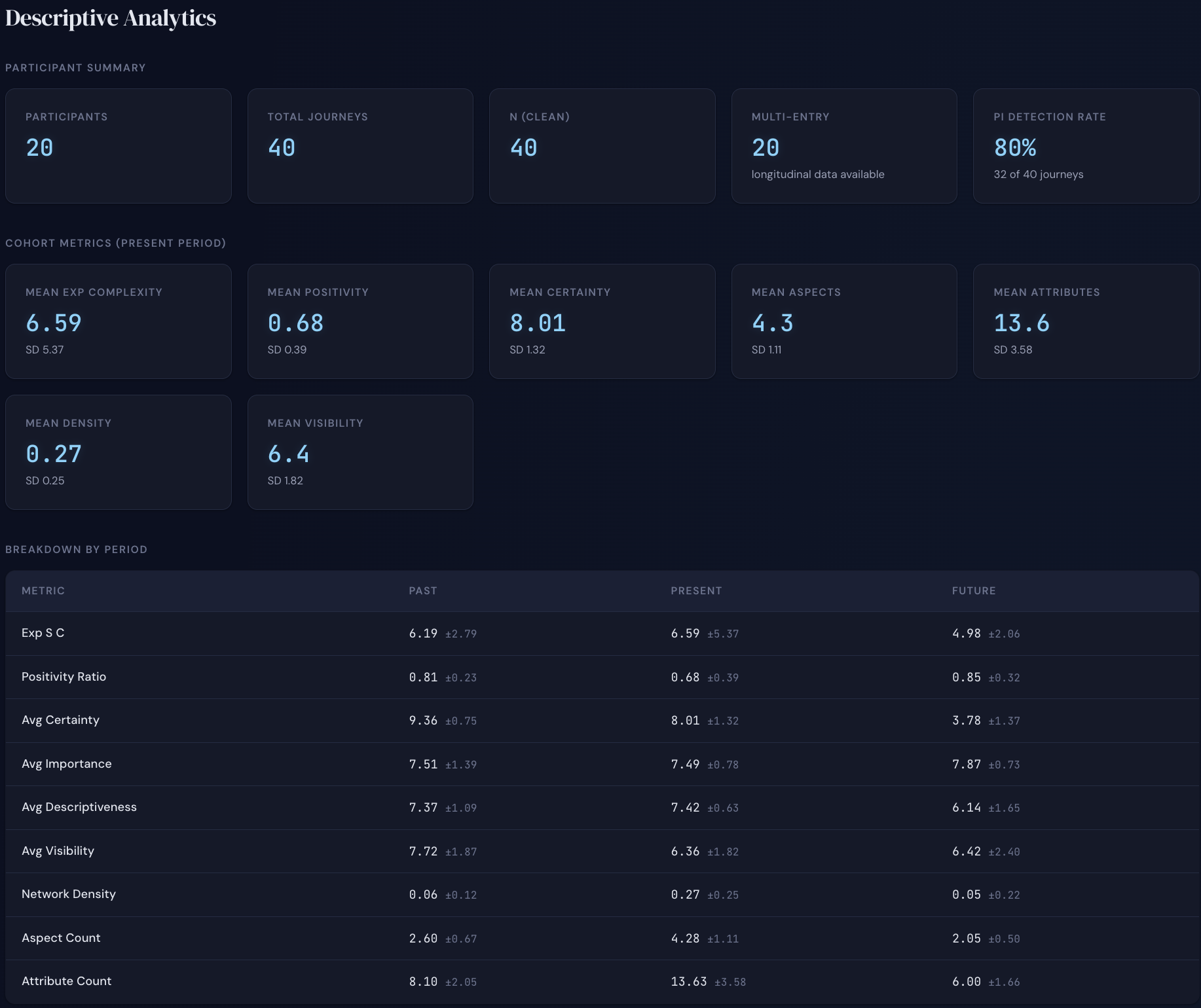
Identity Space shows self-aspects as a connected network across a cohort. Alongside it, the profile metrics and structured tables provide the quantitative scaffolding — distribution, change, and structure rendered in numbers as well as nodes.
This ecosystem works because each layer has a distinct job. Together they create a public-facing network, a larger research movement, and an Illinois-based engine for execution.
Revisiting theory, standardizing measurement, and advancing new metrics for the next generation of self-complexity research.
A growing collaboration of researchers, students, and developers contributing across disciplines and domains.
A research engine at the University of Illinois driving tools, studies, training, and future center-building.
Self-complexity research extends far beyond psychology. This hub is designed to welcome collaborators wherever identity structure, role organization, development, performance, adaptation, or self-concept matter.
Psychology, kinesiology, public health, cognitive science, and related areas examining adaptation, functioning, resilience, and identity.
Researchers exploring professional identity, learning, belonging, leadership development, transition, and self-concept in institutions and teams.
Performing arts, business, coaching, design, and other applied spaces where identity dynamics shape behavior, creativity, decision-making, and growth.
This is a launchpad, not a brochure. The app and dashboard are live below — open either one and you're inside the working platform.
No installation. No accounts. Fully browser-based.
A dedicated specification page now provides download, citation, and versioned methods framing for psych-oriented scholarship.
The dashboard is more than a visualization layer. It produces interpretable tables, profiles, and analytic outputs ready for reporting and reuse.
Documentation, inspectable browser-based tools, and OSF-ready resources are part of the platform from day one.
The science is accessible without being thin. A few clicks surface the theory roots, the measurement agenda, and the open-science direction of the work.
Literature anchors on one side, working tools on the other. The app and dashboard extend classical self-complexity theory into measurable, inspectable structure.
Documentation and resources aren't an appendix — they're built into the platform alongside the tools they describe.
Associate Professor, Health and Kinesiology; Director, Exercise, Technology, and Cognition Laboratory; University of Illinois Urbana-Champaign.
This project integrates research on identity, behavior, and digital health to advance the science and measurement of self-complexity.